Eliminating Operational Technology Lateral Movement Through Decentralized Zero Trust Architecture
The Anatomy of Lateral Movement in Modern Operational Infrastructure
Initial system compromise is a statistical certainty, whether through a single phishing email, an unpatched edge gateway, or a stolen credential. However, the initial point of entry is rarely where the true damage occurs. The real threat to industrial infrastructure is lateral movement—the systematic exploration and traversal of the internal network by an attacker seeking high-value operational assets. Once an adversary secures a foothold, they immediately begin probing for pathways to sensitive databases and controller interfaces.
In legacy operational technology (OT) environments, security has long relied on physical separation or perimeter-based segmentation like the Purdue Model. These architectures depend heavily on firewalls to guard boundaries between network zones, trusting that what lies behind the barrier is safe. Once an adversary bypasses these boundary firewalls—often by compromising a legitimate jump host or abusing an active remote-access session—they enter an environment characterized by broad, implicit network trust. Within these zones, the lack of robust internal segmentation allows threat actors to conduct easy reconnaissance and locate critical endpoints.
Legacy network devices and industrial controllers rarely demand continuous authentication, assuming that any packet originating from the local subnet is benign. This trust allows attackers to scan for open TCP ports, run network discovery protocols, and move laterally from IT workstations directly into sensitive OT environments. Because internal traffic is seldom scrutinized, adversaries can navigate the mesh undetected for weeks or months. Traditional security tools fail to detect this movement because they are designed to inspect traffic at the external perimeter, not to police peer-to-peer interactions within the internal subnet.
The consequences of unrestricted lateral movement in an industrial setting are physical and catastrophic. An attacker who successfully transitions from a corporate network into an operational zone can target programmable logic controllers, human-machine interfaces, and supervisory control systems. By sending unauthorized command packets directly to these units, they can disrupt physical processes, disable safety systems, or shut down electrical grids entirely. Without a mechanism to isolate peer-to-peer communications at the cryptographic level, a single compromised device remains a direct threat to the entire physical infrastructure.
Conflux and the Eradication of Network-Layer Lateral Movement
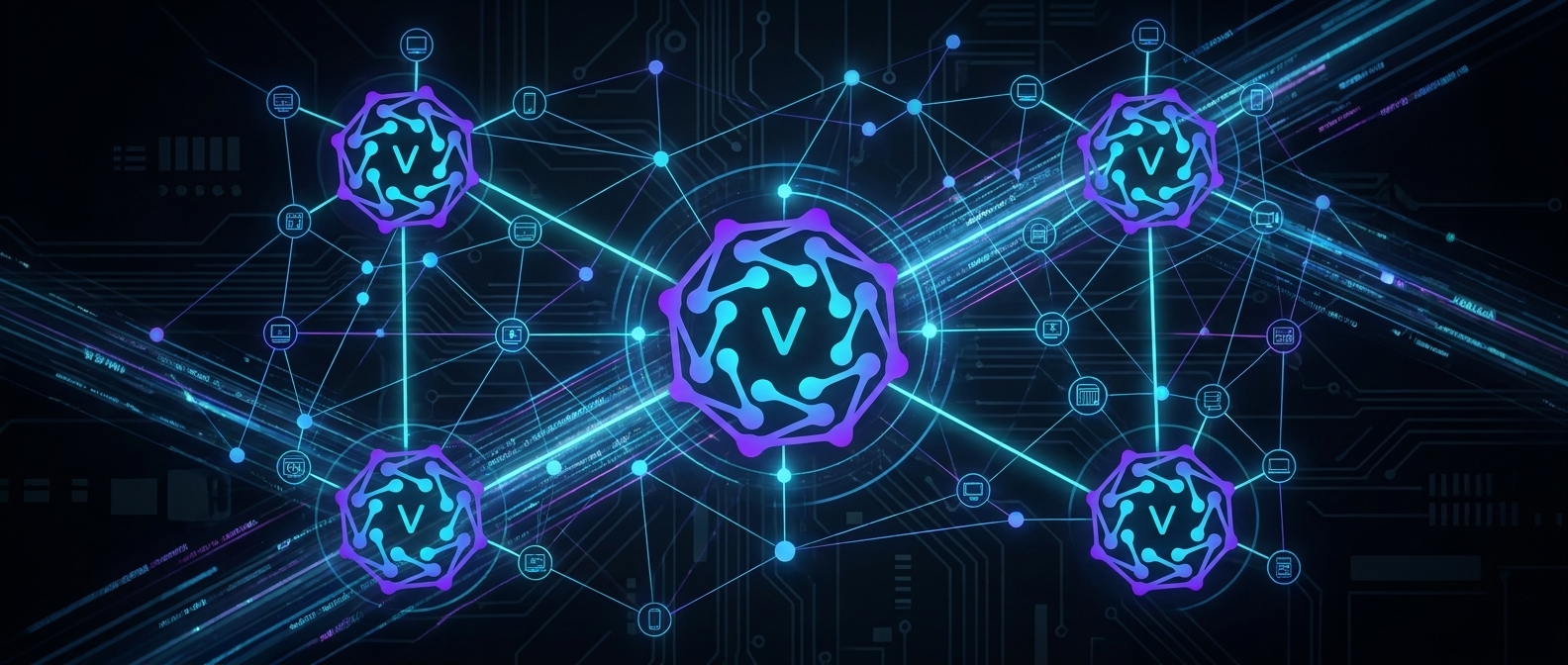
To neutralize the risk of lateral movement, organizations must transition to an architecture where identity is the only perimeter. This requires a paradigm shift that treats the network as hostile at every layer, requiring continuous authentication for every session. This is where VeilNet redefines industrial cybersecurity by separating the network and data planes into two distinct, zero-trust layers. At the network foundation, VeilNet Conflux replaces vulnerable routing with a secure, identity-authenticated mesh network designed specifically to stop lateral progression.
Conflux dismantles the traditional trust model by requiring every node on the network to cryptographically verify its identity before transmitting any data. It does not matter if a device is physically plugged into a local switch or connected via a secure wireless bridge. If the device does not possess a verified, cryptographically bound identity within the Conflux mesh, it cannot establish a connection or send packets. This completely eliminates implicit trust based on logical network location, ensuring that a compromised IT laptop has no pathway to communicate with an operational asset.
Neutralizing Scanning with the Meta Air Gap
Furthermore, Conflux introduces a meta air gap that renders the entire operational network invisible to unauthorized eyes. In a typical network, an attacker can use scanning tools to discover live hosts and open ports, gathering intelligence for a lateral hop. With the Conflux meta air gap, unauthorized devices receive absolutely no response to network probes, leaving them blind. The protected infrastructure does not respond to ping requests, TCP syn packets, or UDP scans, stopping internal reconnaissance before it can begin.
Securing Transit with Quantum-Resistant Packet Routing
As critical infrastructure assets often remain in service for decades, they must also be protected against future decryption breakthroughs, particularly quantum computing. Threat actors currently capture encrypted transit data with the intention of decrypting it later when quantum capabilities become widespread. Conflux addresses this long-term threat by implementing quantum-resistant packet routing across the mesh. By securing all network-layer communications with post-quantum cryptographic algorithms, Conflux guarantees that today's sensitive industrial telemetry remains secure against future decryption techniques.
Protecting the Industrial Data Plane with Aether
While Conflux secures the network layer, operational technology also requires deep security at the application and protocol levels. Industrial operations rely on continuous data exchange between controllers, databases, and enterprise software systems. If an attacker gains access to an authorized workstation, they might attempt to exploit application-level protocols to send unauthorized commands. To prevent this, VeilNet deploys Aether as the dedicated industrial data plane operating directly above the Conflux network layer.
Aether is engineered specifically to handle OPC UA, RESTful API, and MCP integrations. By isolating these key industrial protocols from the underlying transport layer, Aether ensures that all operational data is subject to strict, identity-aware controls. For example, OPC UA traffic is not allowed to traverse the network as raw, uninspected TCP packets. Instead, Aether encapsulates and validates the OPC UA data plane, ensuring that only authenticated applications can initiate specific actions or read telemetry.
Isolation of Critical Protocols and Integrations
Similarly, Aether secures RESTful API endpoints and MCP integrations that connect industrial sensors to cloud analytics and modern machine learning models. Because these modern data integrations often cross traditional IT and OT boundaries, they represent a prime target for lateral exploitation. Aether mitigates this risk by enforcing strict, application-level identity validation at the data plane. An attacker cannot use a compromised API client to query databases or inject commands, because Aether validates the identity and context of every transaction against the underlying Conflux identity registry.
Achieving Multi-Layered Threat Isolation
By decoupling the network layer from the industrial data plane, VeilNet ensures that lateral movement is mathematically impossible. Conflux locks down the network, establishing a quantum-resistant, identity-authenticated mesh that denies the existence of the network to unauthorized actors. Simultaneously, Aether secures the critical OPC UA, RESTful API, and MCP protocols that power modern operations. This dual-layered approach prevents initial compromises from expanding into operational disasters, keeping critical infrastructure secure, resilient, and invisible to adversaries.
Eliminating the Attack Surface of Agentic AI and Industrial Networks
Secure agentic AI workflows and Model Context Protocol (MCP) servers with VeilNet’s post-quantum zero-trust mesh networking and real-time data plane.
Eliminating Operational Technology Lateral Movement With Zero Trust Mesh Networks
Learn how VeilNet Conflux and Aether eliminate operational technology lateral movement through quantum-resistant mesh networking and secure data planes.