How Post Quantum Mesh Networks Shield Legacy Operational Technology
The Friction Between Legacy Industrial Assets and Modern Security Demands
Operational Technology (OT) networks have historically operated under a simple, reliable security paradigm: physical isolation. The physical air gap was the gold standard for protecting critical infrastructure, from power grids and water treatment plants to manufacturing assembly lines. If a programmable logic controller (PLC) or supervisory control and data acquisition (SCADA) system was not physically connected to the public internet—or even the corporate IT network—it was assumed to be safe.
However, the rise of the industrial internet of things (IIOT), real-time cloud analytics, and AI-driven automation has shattered the air gap. To optimize supply chains, perform predictive maintenance, and extract operational efficiency, organizations have rapidly interconnected their legacy OT environments with IT infrastructure.
This digital convergence has exposed a critical vulnerability: legacy OT hardware was never designed with security, identity, or encryption in mind. Many devices use decades-old, unencrypted protocols that trust any command received over the wire. Once an attacker gains a foothold in an IT environment, they can easily pivot laterally into the OT environment, using compromised credentials or legacy pathways to command physical machinery.
While federal agencies and regulatory bodies now strongly recommend implementing zero-trust frameworks in OT settings, security teams face a daunting challenge. Standard IT zero-trust solutions—such as deploying endpoint agents, performing continuous multi-factor authentication, or enforcing granular cloud-based access controls—are technically incompatible with legacy industrial control systems. Trying to apply traditional security structures to these fragile environments risks disrupting real-time physical processes where milliseconds of latency can mean catastrophic downtime.
Why Traditional Network Perimeters and VPNs Fail the OT Environment
To address the challenge of remote access and IT-OT integration, many organizations rely on Virtual Private Networks (VPNs) and traditional perimeter firewalls. However, these solutions introduce critical structural flaws that undermine zero-trust principles.
A VPN grants network-level access rather than application-specific access. When an external technician or an internal OT engineer connects to an industrial site via a VPN, they are effectively placed inside the perimeter. The blast radius of a single stolen VPN credential or a compromised remote-access endpoint extends to the entire local subnet. Once inside, an attacker can freely scan the network, identify vulnerable legacy PLCs, and execute lateral movement.
Furthermore, traditional firewalls and VPN concentrators create visible entry points. They must listen on public-facing IP addresses and open specific inbound ports to receive connection requests. This public footprint makes industrial gateways prime targets for automated scanning, brute-force attacks, and zero-day exploitation.
To truly secure critical infrastructure, organizations must move beyond the perimeter model. They need an architecture that eliminates the public attack surface entirely, authenticates identity cryptographically before granting network access, and secures legacy data streams without modifying the underlying physical machinery.
Restructuring the Transport Layer with Conflux Post-Quantum Mesh Networking
VeilNet addresses the fundamental vulnerabilities of the OT network transport layer through Conflux, a secure post-quantum network connector. Conflux completely reimagines how legacy systems connect, replacing broad perimeter access with an identity-authenticated mesh network.
Instead of routing traffic through a centralized, vulnerable VPN gateway, Conflux establishes secure, point-to-point tunnels directly between authenticated endpoints. These tunnels are constructed dynamically and are bound to strict, cryptographic identities. Every device, gateway, and user on a Conflux network must prove its identity before a single packet of data is routed.
This architecture enables what VeilNet defines as a meta air gap. Rather than relying on physical disconnection—which is no longer viable in a connected industrial world—Conflux creates a logical air gap. OT assets protected by Conflux are completely invisible to the public internet. They do not have public-facing IP addresses, nor do they listen on open ports. An unauthorized scanner querying the network will find absolutely nothing, effectively neutralizing external reconnaissance and automated exploit campaigns.
Importantly, Conflux prepares critical infrastructure for the impending quantum threat. Industrial hardware often has an operational lifecycle spanning twenty to thirty years. This means that data transmitted across OT networks today must remain secure for decades to come.
State-sponsored adversaries are actively engaged in harvesting encrypted industrial telemetry and administrative traffic today to decrypt it once cryptanalytically relevant quantum computers become available. Conflux mitigates this risk by employing quantum-resistant packet routing. By securing all point-to-point tunnels with post-quantum cryptographic algorithms, Conflux ensures that highly sensitive operational data remains secure against both current classical threats and future quantum adversaries.
Powering the Industrial Data Plane with Aether
While Conflux secures the network transport layer, industrial operations require a way to safely process and translate data from legacy protocols. This is where Aether, VeilNet's real-time engine, operates. Aether sits directly above the Conflux network layer, acting as the secure industrial data plane.
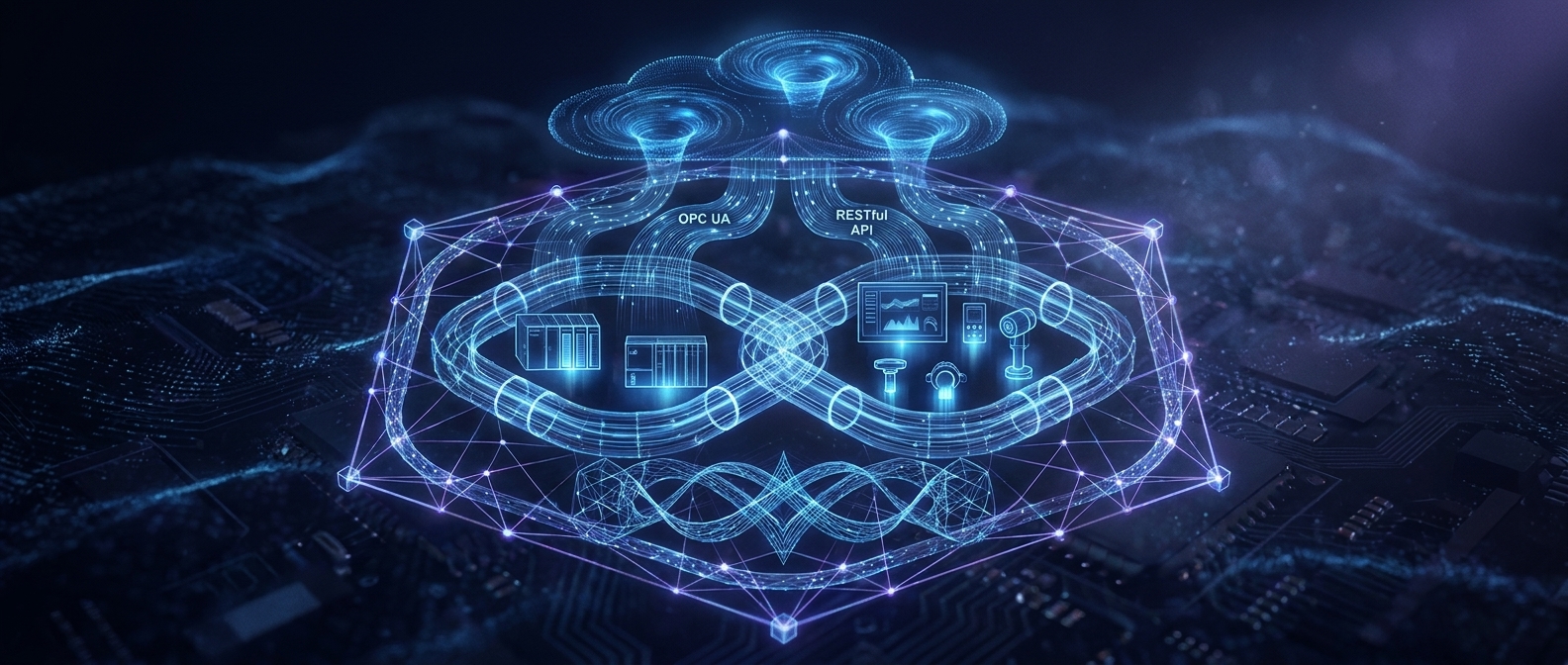
Legacy OT environments rely on specific protocols like OPC Unified Architecture (OPC UA) to transmit telemetry from sensors and PLCs to supervisory applications. Aether natively integrates with OPC UA, providing a secure proxy and translation mechanism. By running Aether over Conflux, organizations can securely extract, encrypt, and route OPC UA telemetry across the WAN without exposing physical PLC interfaces to direct network interaction.
In addition to legacy protocols, modern industrial organizations rely heavily on web APIs for cloud integration, enterprise resource planning (ERP) syncs, and remote operations. Aether handles RESTful API integrations natively, allowing OT teams to expose specific, authenticated microservices to authorized IT applications. Every API request is checked against a centralized, cryptographic authorization policy at the edge, ensuring that no unauthenticated or unauthorized command ever reaches a physical actuator or controller.
Looking toward the future of industrial automation, Aether is also equipped to support advanced machine-to-machine and artificial intelligence workflows. It integrates with the Model Context Protocol (MCP), a standard designed to connect AI models and autonomous agents with local data sources and tools. As organizations begin deploying an agentic workforce—using autonomous AI systems to monitor telemetry, run diagnostics, and optimize process loops—Aether provides the secure interface they need. It ensures that AI agents can query real-time OT data and initiate approved control actions safely, without introducing unregulated non-human identities into the physical network.
A Pragmatic Blueprint for OT Zero Trust Implementation
Implementing zero trust in an active operational environment does not require a disruptive, "rip-and-replace" overhaul of legacy machinery. By combining Conflux and Aether, organizations can deploy an overlay architecture that secures existing systems in place.
- Establish the Mesh Network (Conflux): Deploy Conflux gateways at the edge of OT cells, micro-segmenting the physical environment. Legacy PLCs and HMIs are grouped into secure local segments, isolated from the corporate IT network.
- Eliminate the Public Profile: Configure Conflux to close all inbound firewall ports. Network endpoints communicate via outbound-only connections to establish peer-to-peer mesh tunnels, rendering the entire OT footprint invisible to external scans.
- Deploy the Industrial Data Plane (Aether): Utilize Aether to bridge legacy protocols like OPC UA and RESTful APIs over the secure Conflux transport layer. This allows SCADA systems, historians, and enterprise analytics tools to securely consume OT data.
- Integrate Advanced Operations: Leverage Aether's MCP support to safely integrate modern diagnostic tools and AI agents, paving the way for autonomous optimizations without compromising physical safety.
By separating network transport security from application-layer data processing, VeilNet allows CISOs and OT engineers to meet modern regulatory standards, protect critical infrastructure from advanced state-sponsored actors, and confidently embrace digital transformation.
Overcoming the Critical Zero Trust Data Movement Bottleneck
84% of leaders say data movement is the Zero Trust bottleneck. Learn how VeilNet's Conflux and Aether solve this with post-quantum mesh networking and meta air gaps.
Preventing AI Agent Lateral Movement with Cryptographic Mesh Networks
Learn how quantum-resistant mesh networks and API data plane validation prevent autonomous AI agents from exploiting legitimate credentials to move laterally.