Securing Tactical Edge Networks in Contested Environments with Post Quantum Zero Trust
The tactical edge is inherently hostile, frequently disconnected, and highly contested. In remote environments—ranging from municipal water systems to tactical military bases—network connectivity is rarely guaranteed. Most zero-trust frameworks assume a continuous, high-bandwidth connection to a cloud controller, creating an immediate failure point if that link is severed. When connectivity is lost, the entire security posture collapses, leaving remote systems vulnerable or completely inoperable.
Relying on a persistent backhaul to a centralized Identity Provider introduces a critical single point of failure. If communications are jammed or fiber lines cut, local nodes cannot re-authenticate or download security policies. Traditional Zero Trust Network Access solutions rely on SaaS control planes to validate user sessions. Without this continuous cloud heartbeat, edge systems must either default to open access—creating an immediate security vacuum—or shut down completely, halting vital operations.
Furthermore, transport networks carrying edge telemetry are deeply untrusted. Adversaries monitor satellite beams and regional transit lines to capture operational payloads. Because legacy systems use classic encryption, adversaries can record encrypted traffic today to decrypt it later once quantum computing matures. This "harvest now, decrypt later" model exposes critical infrastructure to long-term risk. Without immediate post-quantum security at the transport layer, every packet sent over a contested link is a future intelligence asset.
Exposed network interfaces compound this threat. When remote assets run standard web services or industrial gateways, they expose open ports to the network. Adversaries use automated scanning tools to map network topology and launch targeted exploits. Edge networks require a way to communicate securely without revealing their physical presence or system architecture to the public internet.
Decentralized Network Resilience via Conflux
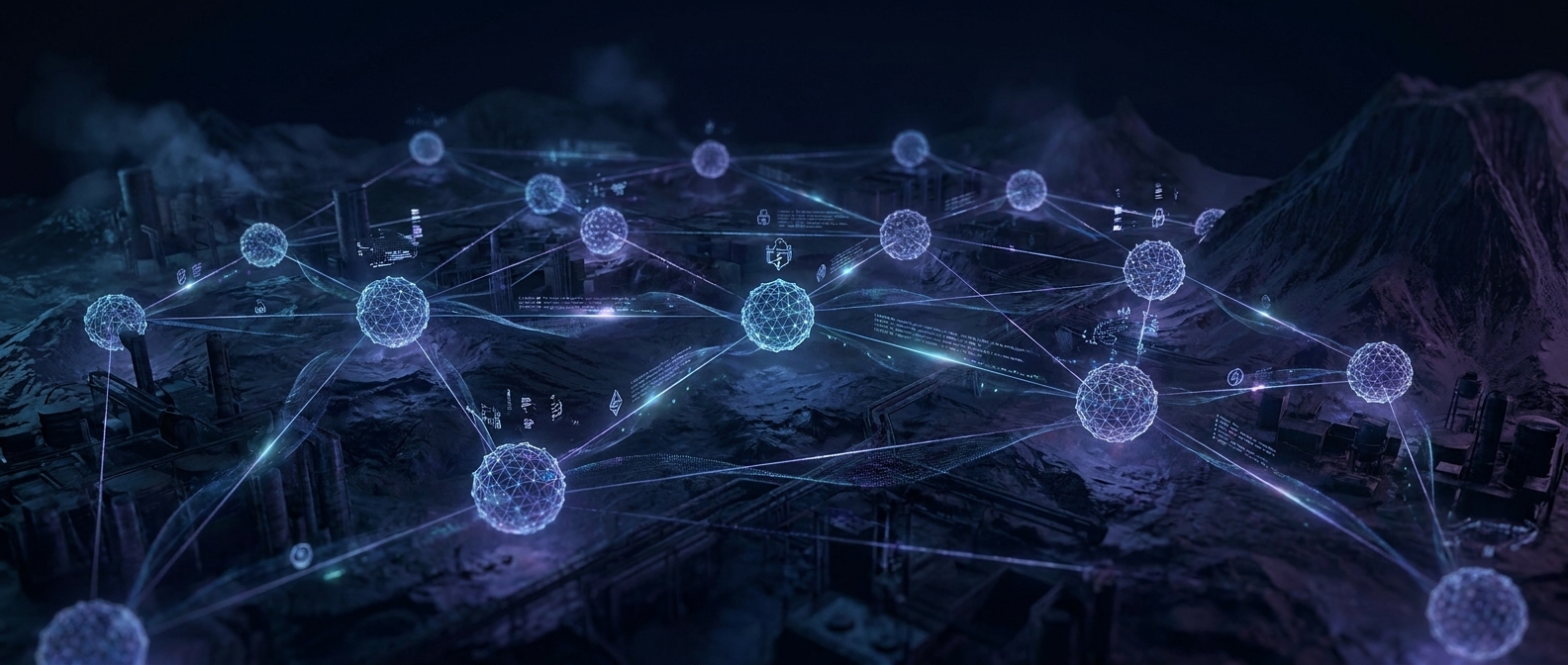
Operating securely in disconnected zones requires shifting away from centralized verification models. Conflux, the network layer of VeilNet, solves this by establishing an identity-authenticated mesh network directly between edge assets. Instead of routing traffic through a centralized VPN or relying on a remote controller, Conflux validates identities peer-to-peer. Each node functions as an independent cryptographic entity, maintaining operations even when completely isolated from the broader internet.
By eliminating the centralized controller bottleneck, Conflux ensures that local systems communicate securely during a blackout. If a remote utility site loses its primary uplink, the local Conflux mesh continues to enforce zero-trust access policies across local peer connections. This decentralized routing dynamically adjusts to link degradation, finding the most resilient path across available local interfaces without exposing plaintext data.
Establishing a Cryptographic Meta Air Gap
To prevent adversaries from discovering and mapping edge infrastructure, Conflux implements a meta air gap. Traditional physical air gaps are fragile, easily bypassed by maintenance laptops or USB drives. The Conflux meta air gap achieves this isolation cryptographically on connected networks, using Single Packet Authorization to hide all listening network ports.
To an external scanner, a Conflux-protected node appears entirely dark. The node will not respond to TCP SYN packets, ping requests, or port scans, neutralizing automated reconnaissance. Only packets containing the correct, pre-verified cryptographic authorization signature are accepted by the interface. This mechanism protects degraded edge networks from being overwhelmed by brute-force attacks or automated exploit attempts.
Post Quantum Cryptography for Long Term Data Protection
To neutralize the threat of adversarial packet interception, Conflux embeds quantum-resistant packet routing directly into the transport layer. Traditional encryption algorithms are vulnerable to quantum decryption. Conflux replaces these fragile protocols with state-of-the-art post-quantum cryptographic primitives.
By encrypting transit traffic with quantum-resistant algorithms, Conflux ensures that captured data remains unreadable, even to future quantum adversaries. This protection is critical for systems with multi-decade operational lifecycles, such as power grids and water plants. Security is enforced packet by packet, ensuring that every piece of tactical telemetry is cryptographically isolated.
Hardening the Industrial Data Plane with Aether
Securing the network transport layer is only the first step. Tactical and industrial operations run on complex, application-specific data protocols that are notoriously difficult to secure. Aether operates directly above the Conflux network layer to secure the industrial and application data plane. It acts as an intelligent gateway, translating and filtering raw telemetry before it is transmitted across the mesh.
In contested environments, legacy protocols like OPC UA are highly vulnerable to command injection and protocol manipulation. Aether ingests OPC UA telemetry at the local edge, validating every payload against strict schema definitions. By enforcing zero-trust principles at the data layer, Aether prevents malicious commands from traversing the network, even if an adversary gains physical access.
Securing Modern APIs and Machine Integrations
Modern tactical environments increasingly rely on RESTful APIs and machine-to-machine integrations to coordinate automated responses. Aether secures these interactions by terminating API calls locally and enforcing strict access controls. It strips away unnecessary headers, validates request structures, and normalizes payloads before passing them through the Conflux mesh.
This protocol normalization reduces the attack surface of edge applications. By ensuring that only schema-validated payloads reach their destination, Aether protects critical microservices from application-layer exploits. This defense-in-depth approach is vital when local networks run under degraded conditions with limited administrative oversight.
Protecting Agentic Workflows and MCP Integrations
The introduction of autonomous agents at the tactical edge introduces new security vectors. These agents often communicate via the Model Context Protocol to access local databases and coordinate physical operations. Aether provides native MCP integrations, enforcing strict policy boundaries on what data an autonomous agent can read or write.
By regulating MCP traffic, Aether prevents compromised agents from executing unauthorized actions or exfiltrating sensitive telemetry. This integration ensures that autonomous systems can be safely deployed in contested environments. Security teams maintain granular control over agent capabilities without needing to constantly manage individual endpoints.
A Resilient Architecture for Contested Operations
Securing the tactical edge requires a complete departure from centralized, cloud-dependent architectures. The combination of Conflux and Aether provides a fully realized zero-trust framework designed specifically for contested, degraded, and isolated environments. By decoupling security from the public internet, organizations can maintain absolute operational integrity under the most extreme conditions.
With Conflux establishing an invisible, quantum-safe transport mesh and Aether validating every industrial protocol and API payload, the tactical edge is no longer a vulnerability. It becomes a hardened, self-sufficient enclave capable of resisting both modern network attacks and future quantum threats.
Securing Smart Building Operational Technology Against Lateral Movement
Protect operational technology and smart building networks from lateral movement with VeilNet's post-quantum zero-trust Conflux and Aether engines.
Securing the Autonomous Edge and the Future of Machine Identity
Learn how VeilNet closes the identity gap for nonhuman workloads and smart systems using post-quantum mesh networking and real-time industrial data planes.